1975 — Present ● Two intertwined histories
The history of BAPTO
A commercial story about the companies that built Britain's network of pub pool tables — and a sporting story about the organisation that standardised English 8-ball.
Origins
1975
A game everyone played and nobody agreed on
In 1975 English 8-ball was hugely popular and completely inconsistent. Regions played to different rules, tables varied between manufacturers, equipment differed from venue to venue, and there was no universally recognised standard for competitive play.
The British Association of Pool Table Operators was established as a non-profit trade association representing the companies that supplied and operated coin-operated pool tables in pubs, clubs and licensed venues across the United Kingdom. Its membership was commercial — operators, manufacturers, suppliers — but its ambitions were not confined to the business of operating tables.
BAPTO set out to standardise the game itself, to promote pool as a recognised sport rather than a pub pastime, and to create opportunities for players at every level to compete nationally. Its stated goal was direct:
“To develop the potential of the sport of 8-ball pool and ensure its recognition in all its forms as one of the leading leisure and sports activities.”
The mission behind it had three parts: encouraging cooperation and shared best practice among members, fostering the growth of 8-ball pool in all its variations, and working to raise pool's standing in the media as a leading sport and leisure activity. Members described the ambition as being “Investors in Pool”.
Seven feet. Two-inch object balls. A cue ball at one and seven-eighths. Still the British pub table.
Standards
& rules
The specifications that became English pool
Working alongside the British Amusement Catering Trades Association (BACTA), BAPTO helped define the specifications for the familiar British pub table: the 7-foot size, 2-inch object balls and the smaller 1⅞-inch cue ball. Those standards remain instantly recognisable and still influence English pool equipment decades later.
BAPTO also produced one of the first nationally recognised rule books for English 8-ball. Before it, leagues played to local interpretations, which made inter-league competition awkward at best. BAPTO's rule posters became a common sight in pubs across Britain and gave millions of recreational and competitive players a shared understanding of the game.
Modern competitions often use Blackball rules, but much of today's game traces back to the foundations BAPTO laid.
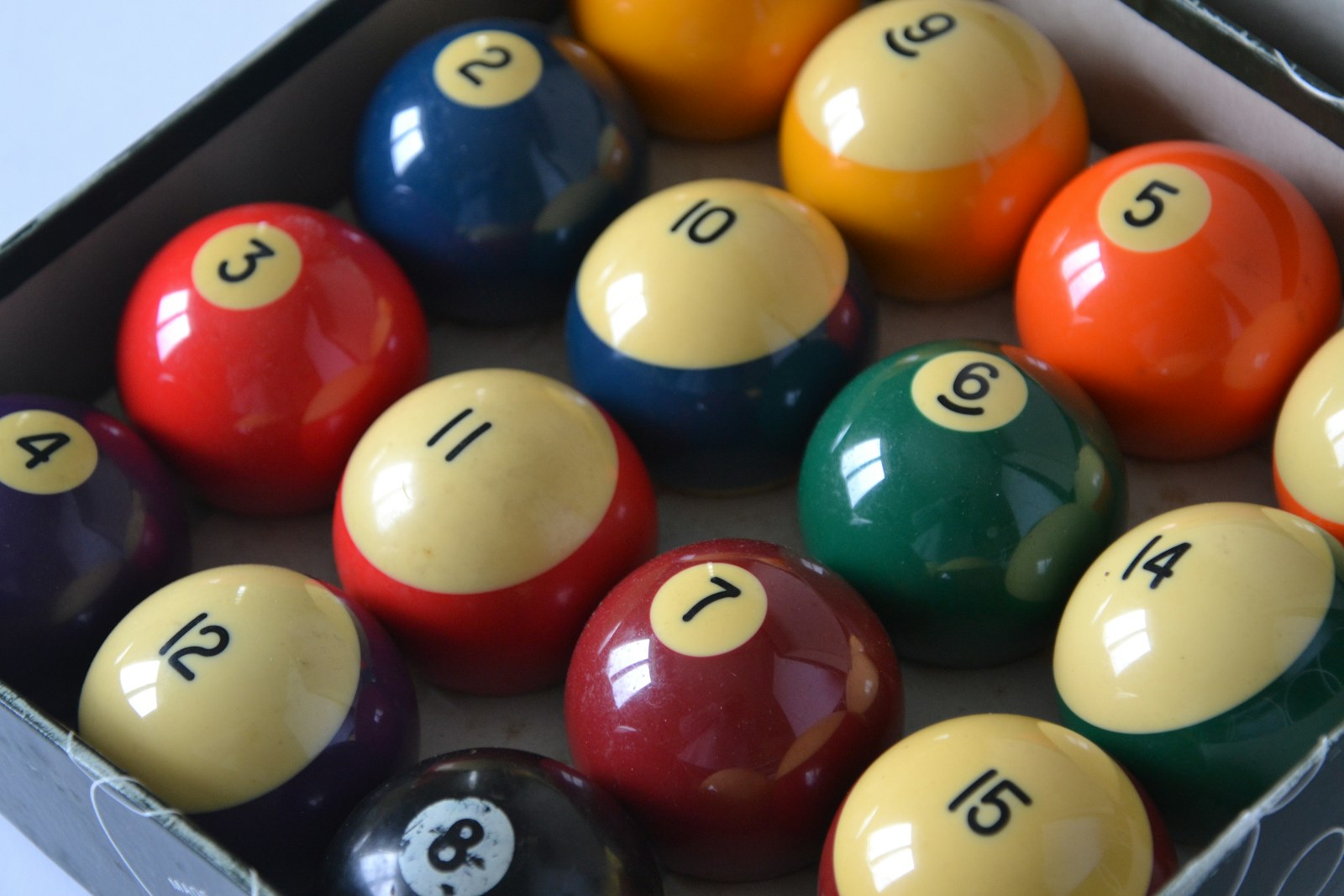
Illustrative image. Photo: Susan Holt Simpson / Unsplash.
Competition
1977 →
The Grand Finals
Competition became central to BAPTO's identity almost immediately. The BAPTO Grand Finals launched in 1977 as a seven-person team championship, bringing together the winning teams from pub leagues around the country.
Over the following decades it expanded. What began as a competition for pub league champions became the premier event in the UK pool calendar, drawing hundreds of teams and players every year.
Event
Introduced
7-Person Team
1977
Men's Singles & 3-Person Team
1981
Ladies
1982
Professionals
1990
UK Fours
— held outside the Grand Finals
1996
In 1996 BAPTO also teamed up with Macmillan Cancer Relief to run a charity fundraising 'fun' pool weekend. Most players came to know the association through its tournaments — but BAPTO remained, fundamentally, a trade body.
The trade
side
A trade association, first and last
BAPTO represented the interests of businesses operating pool tables within the licensed trade, and later became involved in wider industry matters affecting amusement machine operators. Evidence submitted to UK Parliamentary committees shows it actively representing members on pub company agreements, machine income and the commercial environment for licensed premises.
That commercial heritage matters. It distinguishes BAPTO from governing bodies concerned only with sporting competition — the tables had to be a viable business before anyone could play a national final on one.
Who was in it
Membership spanned large national, regional and family-owned operators in the UK, Eire, France and Spain, together with pool table manufacturers, industry suppliers and cue makers.
Beyond the commercial sector, BAPTO also represented players through bodies including the Welsh Pool Association and the England Pool Counties Federation, each with its own referee body, alongside associations from Ireland, France and Spain.
The
chairmen
Seven men held the chair
BAPTO was led from 1975 until 2014 by chairmen drawn from the operating trade itself — the people whose companies stocked the tables the game was played on.
A. Charles Buck
1975—1980
George S. Muncaster Marlmoss
1980—1983
Bob Blakeborough R Blakeborough & Co.
1984—1986, 2001—2007
Jim Murphy Bell Fruit Services
1987—1988
Malc Ferris Associated Leisure
1989—1993
Tim Drew
1994—2000
Alan Boswell
2008—2014
Legacy
today
Other bodies, one shared foundation
As English pool grew through the 1980s and 1990s, other organisations emerged for players, counties and international competition — the English Pool Association, later the English Pool Counties Federation, and the international Blackball bodies. Different governing bodies adopted different rule sets, and for a time major competitions ran under slightly different versions of the game. Historians still credit BAPTO as one of the organisations that laid the foundations for the modern sport.
The original association no longer operates as an active trade body. Its legacy runs through the annual BAPTO Tournament, now organised by UK Pub Pool: the UK's longest-running amateur pool tournament, still attracting teams from across Britain and Europe.